Before she arrived, across Europe, it had been decreed that the cuisine should be made fine. The vegetables should be cut into fine pieces. The meats should be served in fine portions, the spices sprinkled in fine measure, the servings dished up on fine plates. This fine food should be eaten by fine people, who demonstrate fine manners; it should be served in fine rooms which display fine art, and be finely presented by finely trained waiters. The chefs, too, should be fine in their technique and stature; most of all, they should be of fine character, refined in their every move, delicate in their every way.
It had been appointed that the people should take pleasure in this food. And they did. This piddliest sliver of herring, that gently pickled carrot, those two perfectly velouted peas. The food was delicious, undoubtedly, but, oh! My! Did the people not yearn for more? Did their bellys not ache after the last frogs leg was swallowed clean, that final snail suckled from its garlicy shell? Was it always appointed that the meal should end when it was not yet half begun? Was it always written that the door should be slammed shut, just when the dazzling light had half begun to blaze through? And did their bodies, their hearts and their souls not cry out, together, in one single voice, ‘Pudding! Pudding! PUDDING!’
The people did cry out: their cry sounded loud over the marshlands and lowlands of Flanders. It rang out over the fields of Walloon and into the forests of the Ardennes. It bellowed southward over the snow-capped peaks of the Alps and the Pyrenees, westward into sandy Spain and eastward to the grassy Caucasus plains, until all over Europe, from the Baltic to the Mediterranean, the peoples’ cry echoed around and the mountains were ringing to the sound of that hopeful refrain, ‘Pudding! Pudding! PUDDING!’
As the tune played, so Europe’s concert responded. The finest culinary nations, in fierce competition, summoned their greatest minds to the table. All the wisest chefs, with all the deftest instruments, came in turn to answer the call. The haughty French combined their talents to compose a delicacy of one thousand layers, the floatiest creme upon the daintiest puree, rhyming freshness with richness, a song of fruit played to the melody of custard: “Le Millefeuille, Madame.” It was exquisite, undoubtedly. The slender Italians, cursing the haughty French, united to orchestrate their own masterpiece: double cream and mascarpone, whipped lighter than air itself, layered upon ladyfingers dipped in a shallow plate of Tuscany’s lushest coffee and repeated, sprinkled finally with the dustiest cocoa: “Il Tirimisu, Signore.” It was magnificent, certainly. The cross-eyed Britons stumbled in, confused and uninvited, with their two favourite ingredients. They stirred in their butter, looked around, before lumping in their masterstroke. Behold: “Bread and Butter pudding, Mister.” It was interesting, for sure.
At the close of day, the judges retired. With hushed voice, they debated the merits of the cuisine laid before them. They discussed each dish, hot or cold, soft or firm, salty or sweet; they considered presentation, texture, temperature; they even touched on the naming of the dishes, praising the Britons’ precision. Outside, the people waited. Vast crowds had arrayed themselves, pressed against the railings, their tongues licking at the air that bore the scent of those novel dishes as it drifted through, their bellies yearning for what lay behind those walls. From the tips of their ragged shoes to the peaks of their torn hats they strained upwards, tilting back their spindly necks to inhale that glorious smell; eyes closed, lips pursed, a wave of deep pleasure seeps over them; their frowns disappear, their cheeks soften in bliss, their lips softly part as they breathe out.
But as night draws in, one frown does reappear. He explains, confused, that the wind is behind them; that golden scent that knits the air cannot, he reasons, be drifting from those walls before them. One by one, the brows furrow. One by one, the heads turn toward the broad fields behind which stretch into hills and meadows beyond. And one by one, they discover that it’s true – the smell is richer behind them! What greater waves drift over them now! What headier pleasure, what purer delight comes their way! And yet – how? Is this some trick of the senses? Is this some deceit?
In the distance, on the furthest hill, a tiny speck blots the horizon. As the first stars begin to dot the night sky, the blot moves imperceptibly nearer. The crowd strain to watch as, at a stately pace at first, the blot begins to move towards them. It rolls down hills and through valleys, over fields and through the woods. It dips out of sight behind ridges then reappears above them, growing larger all the time. The blot, no longer tiny, begins to develop some shape: at first, a great vast torso, then tree trunk legs, before finally, atop it, a big bright head, shining faintly red in the moonlight. Nearer it comes, and more the smell grows. The judges, behind their walls, perceive it too. A deeper richness wafts into their chamber, greater by far than the Tirimisu or the Millefeuille. A dull clamour begins to grow outside, behind those railings, among the huddled masses. The people ache, their feet stomping, their breath let out in fits and rasps. The blot moves nearer still. The birds in their nests jolt awake, the bees cease their buzzing, moved to stillness. The palace walls shake; the grounds tremble.
Over the final hill, the blot reappears, now a woman, cast in perfect colour under the moonlight, a small rickety cart rolling over the grass beside her. She is enormous. She is hearty. She is good! Close now, she strides towards the crowds, her great belly swinging. Behind, her dark hair is plaited and thick; before, her big red chin sticks proudly out in front of a great jaw clamped firmly shut. Closer still – beads of sweat roll down her red face, etched into the broadest smile, cheek to cheek, ear to ear, a soft glow that lights the night around her. And as that rickety cart jolts nearer, each bounce on the grass below knocks its contents this way and that, the smell of their mixture changing in the air. The scent overpowers, the crowd growl and purr, the judges watch aghast from their windows.
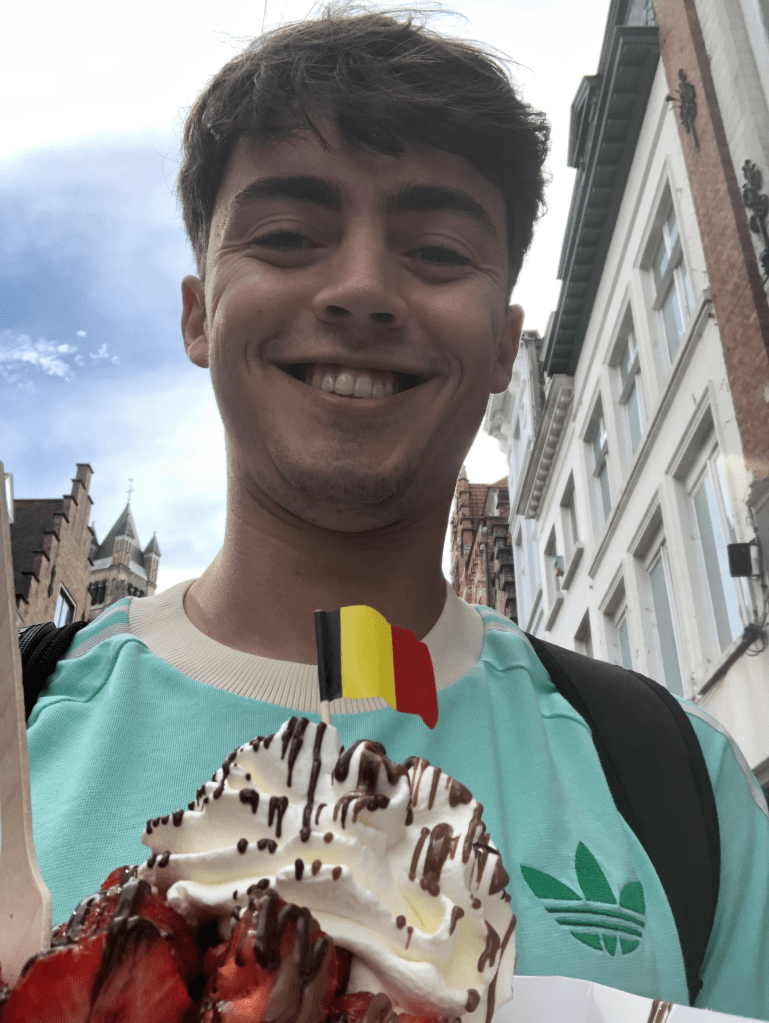
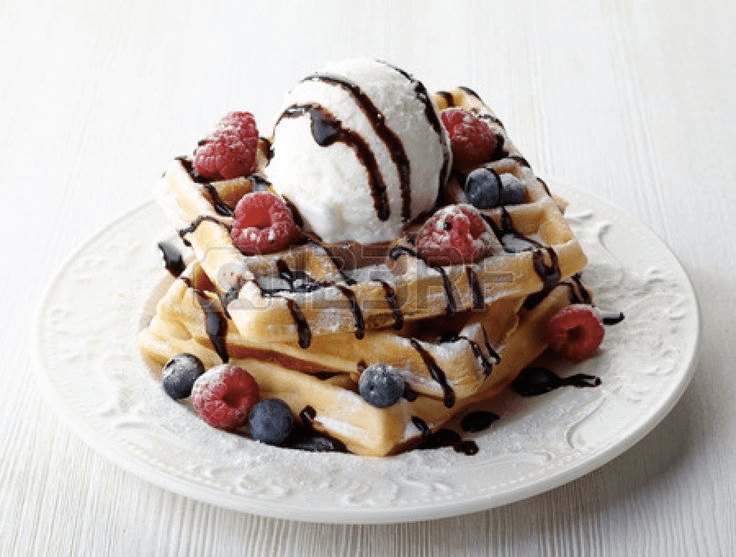
She draws her cart to a halt. She pauses, then plunges her great fists into her pockets and draws out two balls of dough, one stretchy, one thick. In each hand she kneads them. The crowd’s eyes dart this way and that, watching her fold in Belgian pearl sugar and vanilla extract, then slap each ball down into the jolty griddle on the rickety cart beside her. She shuts it: the dough sizzles, it cooks, it grows firm, its edges hardened. Now it turns gold, now its edges tinge brown. The smell thickens and then, in a flash, she flips it open. Light pours out: thick ridges of dough, deep pockets between them, square after square. The people drool, their wild eyes ablaze. Arms outstretched, tongues lolling out their mouths, they press forwards. Inside, the judges storm down the stairs, tripping over each other in their rush to this great lady outside. She raises her chin proudly. Onto these walls and squares of dough, she begins her dread work: a soft stream of caramel; a sprinkle of powdered sugar; a handful of fresh raspberries; double cream; whipped cream! Nutella! Sliced Bananas! Cinnamon! Hot Chocolate Sauce! Golden Syrup! Maple Syrup! Cinnamon! Fudge! Lathered, layered, dolloped! All furnishings, all dressings upon the great foundation underneath, those hearty squares and rows that sit clothed in the messiest cloth that Flanders and Walloon ever conceived of, the golden brown vessel for these delights – the Mighty Liege Waffle, the Whopping Brussels Waffle!
Needless to say, those people ate. They gorged themselves on the Liege Waffle, they stuffed themselves with the Brussels Waffle, they begged for more, they worshipped that great big lady from over the hills. The judges sat with them too, their fine manners forgotten, their hollow eyes shot with delight, their lips messy with red and brown. The people were spindly and spiny no more: one by one, they looked down to see great moral bellies, full of great moral food, no more suckling on the shells of snails, nor snatching for slimy things and frogs legs in the half-light after dinner. The judges – or those present on the day – were no longer connoisseurs of finery, haughty in their refinement, but they grew great big bellies too and became the famous gourmands of the lowlands, their appetite only satiated by a great waffle pudding. And from the Baltic to the Mediterranean, from the Spanish desert to the Caucasian steppe, the whole people of Europe could finally cry, in one voice, “PUDDING‼” and could finally, at long last, be full.
 Why I Write Such Good Blogs