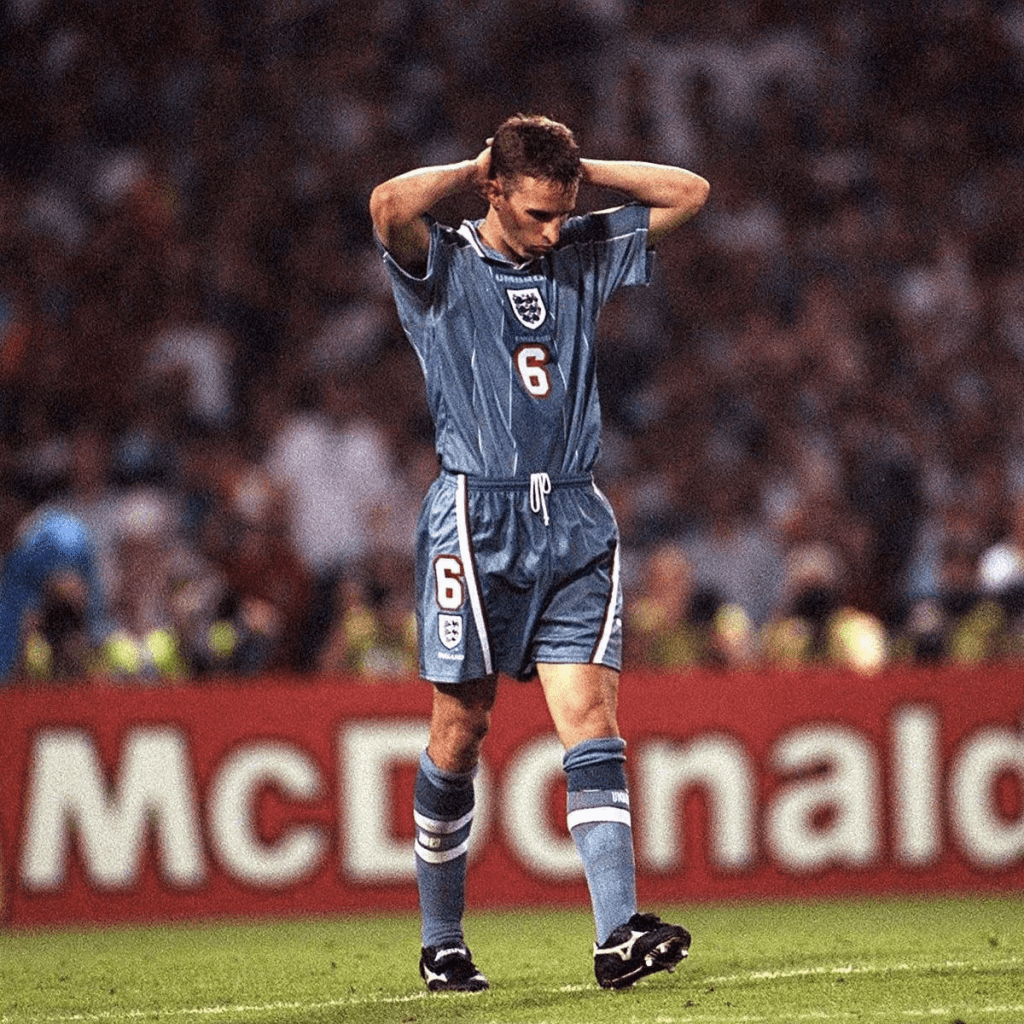
In 1996, Gareth Southgate missed a penalty for England against Germany at Wembley. That meant England lost, and were knocked out of the Euros. In 2018, now as manager, Gareth Southgate led England into a penalty shootout against Columbia in the World Cup. Since his miss, England had lost to Argentina on penalties in the 1998 World Cup, to Portugal on penalties in the 2004 Euros, to Portugal on penalties in the 2006 World Cup, and to Italy on penalties in the 2012 Euros. England had never won a World Cup penalty shootout. At 2-2, Jordan Henderson missed England’s third penalty. And then Columbia missed one, Pickford saved another, and England won.
In 2021, England played Italy at Wembley in the final of the Euros. With the game tied in the final minutes of extra-time, Gareth Southgate substituted on Marcus Rashford, Jadon Sancho and Bukayo Saka in anticipation of a penalty shootout. All three missed, and England lost.
‘Dear England’ is a play that tells this story, letting the audience think about how it connects to other ideas – culture, leadership and in particular, what it means to be English. These are themes that go well with the the play, but Dear England is also about Gareth Southgate: what does his story mean?
It has a beginning, in 1996, and a middle, in 2018, but the end isn’t clear. When England played Italy in the Euros final, and the game went to penalties, the character arc of Gareth Southgate was written. He would have broken the cycle, redeemed himself from his greatest failure, and out of his trials taken a new English generation where they hadn’t been before. Vindication for a decent, kinder approach to the sport would have been his reward. Turning defeat into victory, not just for himself, or his team and country, but for his approach to management and sport itself – that would have been a happy ending.
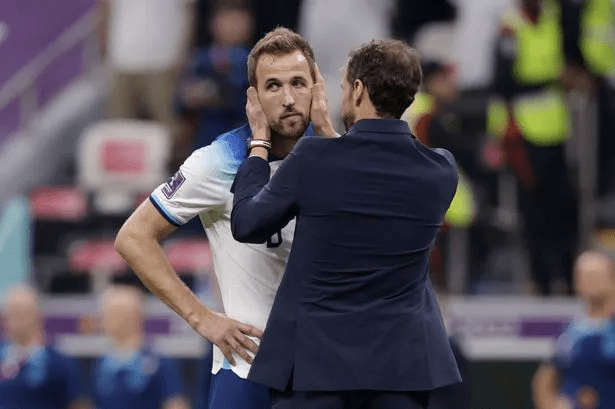
But that was not the end he got. Instead, with the cruellest irony, Gareth Southgate’s story was re-enacted not once but three times. History did not repeat; it played a bells-and-whistles, iMax version of itself, complete with an all-star cast of three young black men, brought on to save the day, ruining it instead. Gareth Southgate found his role not as redeemer but as the comforting arm round the shoulder of three people in a position he knows better than anyone.
And then that story had a postscript. Harry Kane is the man Gareth Southgate made captain. He is a leader in the Southgate mould: quiet, dependable, decent. He faces the same criticism as Southgate for not being a ‘winner’, not being tough enough. He never misses penalties – until the 84th minute in the 2022 Qatar World Cup, with the semi-final poised at 2-1 to France, on the brink of becoming England’s record goalscorer, he missed.
Lionel Messi’s eventual victory at that World Cup over France in the final represented a different character arc coming to a close. For football’s greatest player to have finally won football’s greatest prize seemed inevitable the instant it happened. Looking back at his path, we see destiny in every moment, each turn and obstacle filled with the meaning it later took on, the many perilous moments leading up to that last one, all appearing in hindsight like a chain whose each link would always have led to the next. Emi Martinez’s left leg at full stretch against Kolo Muani; Aurelien Tchouameni scoring from 30 yards against England but missing from 12 against Argentina – these are culminations of years of training, tactics and mind games, yes, but they are also tosses of a coin, moments of variance frozen in time and nodded into the story ahead of a thousand other endings. It is too much to think about all of the other possible paths, and the divergent histories that each tiny difference would have made. Messi takes the ball across Nathan Ake, feints back, then goes again to play a reverse pass between Ake’s legs, the ball emerging into the path of Nahuel Molina through the gap behind Virgil Van-Dijk and in front of Daley Blind. We pause it, rewind, and think we can retrace a path. But there was no path, except the one he made whilst going through.
Messi’s victory was not always destined to turn out how it did; he had to take it for himself. In that journey, he too struggled with the weight of what it means to be Argentina’s greatest footballer, as the legacy of Maradona’s greatness loomed over him both as a player and as a reflection of how Argentinians like to imagine themselves. Maradona, fiery, indomitable, outspoken, was the model against which the unassuming, introverted Messi would sometimes be unfavourably compared in Argentina: not a ‘proper’ Argentinian, too well-behaved, too European, too Spanish. Eventually, Messi managed to justify and dignify his own model of being Argentinian and step out of Maradona’s shadow – but to do that, he had to win.
Dear England shows us what the weight of that kind of national history and collective pressure means to individuals. By letting the audience into the dressing room and into the players’ private moments, the play reminds us that these are ordinary people carrying a lot of other peoples’ hopes on their backs. In one scene, a YouTube channel interviews a wide cast of England fans on stage – shopkeepers, nurses, builders – and asks them what they make of the England team, to which they give the usual range of praise and vitriol, obsession and disinterest which we have all seen before. But by making the general public a ‘character’ in the play, Dear England asks us to recognise our own role and individual agency in the national story of England. It shows England the nation, like England the football team, as a changing, living idea, made up of the combination of what we all think and do. It is the incorporation of not just the players – or the government or the state – but everybody, all playing their individual part, all joining together to animate this idea, presenting and re-presenting old themes and threads with a modern accent, building a new story out of the old ones. The Three Lions on the shirt are no longer the crest of Richard the Lionheart crusading in the Middle East – they can mean to us what we want them to mean, symbols that are filled with new significance for each generation. No longer does the England football team have to mean Gascoigne’s tears, or the BNP and terrace violence, it can now mean diversity, or supporting kids on free school means, or winning penalty shootouts, or winning the World Cup. ‘England’ appears a bit like the Ship of Theseus, where each part is replaced over time with a new one, so that the overlaps between the parts instils a continuity but their regeneration also provides a freshness, and the vessel that the whole show floats along in is defined by the new parts that make it up, just as its shape calls back the echo of its earlier forms and iterations.
It goes without saying, in a play that calls up the defining political questions of England, that this is also all about the nation itself, Brexit, and so on. It says (slightly heavy handedly) that ‘England is stuck’, and that we need to think of new ways to reimagine what it means to be English that can give us a way to move forward. In the play, Southgate asks the players what the England flag means to them, each responding with personal stories about the places they’re from. After a while of back-and-forth, dancing round these ideas, Eric Dier asks Southgate what the answer is – what does the English flag mean? Is it a trick question? “There’s no trick question. It’s up to you guys. It has to come from you.”
Gareth Southgate’s character in Dear England provides a model for how we can change narratives around Englishness. He tries to reimagine what an England football manager can be like. His approach is designed to fix the perceived flaws in previous approaches, and the attitude to the national team in general. Throughout, he avoids pressuring the players to win. His pre-match speech before Russia 2018 is imagined as “Listen lads: relax. You are probably not gonna win the World Cup.” Later, thinking about the abuse and the hate that Sancho, Saka and Rashford received online after their penalty misses, he talks about England’s approach to these moments: “What we need to do, in this country, is to learn how to lose.”
This is the tension in Southgate’s character, between desperately wanting to win and yet wanting to prepare his players and country for the reality of tournament football. It is a tension that we do not have to resolve: he is both a serious competitor and a protective father figure; he is desperate to finally win but knows that, probably, he never will. In this way, he is a model for thinking about England that goes beyond old glories and tries to imagine the future without letting it be defined by the past, without letting past achievements weigh too heavily on what England means today. And yet – it keeps coming back to penalties. He wants to tell a new story about England but he can never fully escape the one that created him.
That the arc of Lionel Messi had the perfect ending seems fitting. It was a crowning moment, made grander by how many times the greatest player had been denied that prize. Stories should have good endings. We want Gareth Southgate’s story to have one. But perhaps it would be more fitting for it to keep looping, like a broken record, over and over again. Harry Kane could lead England to defeat as manager in 2042, and put a warm arm round his own introverted captain. Or perhaps it should adjust its characters – next time, find a 16-year-old to miss, or a 12-year-old. These cycles, and our attempts to break out of them, are what make the play’s themes so grand. We might like stories to curve round into full circles, with beginning, middle and end, with turmoil and bravery along the way before eventual victory. But maybe reality is more like Gareth Southgate than Lionel Messi – history repeats, splattering violently against the wall, and out of the mess it leaves he tries to pick it up again and write a new story, doing his best to learn from the last time.
 Why I Write Such Good Blogs