Clement Attlee, in one of the most effective and respected 20th century governments, took on the ‘Five Evils’ – Want, Disease, Ignorance, Squalor, Idleness – by guiding the young British welfare state towards its maturity. Less well known, although equally important, was the Liberal government of Herbert Asquith, 1906 – 1914, the government that created the welfare state, providing the first measures for health, education, insurance and the like that grew into what we know today. The story of the state after the First World War is, with the odd exception, one of growth, in all directions, across all areas of the citizen’s life. But ideas of the state before that Liberal government, before that War, spanned a far wider range of concepts and philosophies than we would imagine today.
To understand these ideas, we should consider how small and fragile the late 19th century state was. Before the welfare reforms that scaled up its reach into citizens’ lives, before the war proved that weakness meant death, the state’s place – as an object of allegiance, as a core part of peoples’ lives – was unsure. It was one thing among many. And during that time, there were two main competing philosophies of the state. The ‘Idealists’ saw the state as en end in itself, an inevitable consequence of the nature of individuals, who themselves find meaning through participation in the state. The ‘Pluralists’ sought a historical understanding of the state which recognises the diversity of groups that exist within it. They emphasized the meaning individuals find in groups, rather than the state. Rather than authority ultimately being located in the state, pluralists did not make assumptions about where authority does or should lie. It was a more fluid vision, recognizing that there is no one model for the state, but a series of historical contingencies and differences.
And the prescriptive, philosophical confidence of the idealists, was by and large, unnatural to the pluralists. It was the kind of idea that a philosopher would come up with, they thought. The reality of society was an intermingling of allegiances, authorities, and associations. Outdated were the claims of Hobbes, who described non-state formations as ‘worms’ within the Leviathan, existential threats that undermined authority and split allegiances. For the pluralists, developments towards party government in Britain, Europe and across the Atlantic, as well as the thriving community life that birthed the pals battalions of the First World War, lifted the veil from this way of thinking and showed the reality of group life.
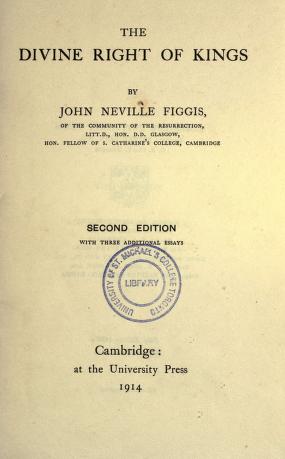
J.N. Figgis, Divine Right of Kings (1896): The main argument, as Runciman characterises it, is that modern political life, unlike earlier eras, is free of absolute claims to authority, from either the church or the state, and is characterised instead by plural authority, plural commitments.
In the early 20th century, pluralist thinkers believed in this kind of society and a state tolerant of association within it. Figgis criticised contemporary sovereign states – they would not allow rights to associations within them, only to the individuals who formed part of those associations. When people come together to form these groups, he argued, they create something beyond the sum of their parts. What they create is a ‘corporate personality’ – something that has, in some way, a life of its own, something with a kind of ‘personhood’ that should be recognised in law. In other words, those people have become ‘incorporated’ together; they have formed a corpus, a new body, a ‘corporation,’ that still exists even after every founding individual has gone and been replaced by a new one. Our lives are full of these corporations, Figgis argued; football clubs and rowing clubs, neighbourhood watches and unions of workers, yet the contemporary state did not account for these groups by codifying their rights as persons.
He held up a well known contemporary court case to make his point. In 1900, the Assembly of the Free Church of Scotland decided, by a vote of 643 vs. 27, to join with the United Presbyterians and to form a Union, making those two bodies into one. A landslide vote, the wish of the Free Church of Scotland freely and clearly expressed, its intention clear. Yet the 27 individuals, the people who disagreed with their colleagues, persisted. They argued that joining with the United Presbyterians, who were after all a far less liberal group, would fundamentally change the constitution of the Free Church. It would no longer be the Free Church, but a different thing, a different corporate person entirely. They took their case to the courts, who sent it to the Lords, who, in 1903, agreed with them. The Free Church, said the Lords, was a fixed entity, with fixed standards, set out in its constitution. And that constitution could not be combined with the United Presbyterians’. By attempting this, and thereby violating that constitution, the majority had forfeited their rights to the institution. They had broken the founding rules. The Free Church would now belong in law to the 27.
This law didn’t make sense to Figgis. Groups, like people, evolve. Their interests change. How could the state say that the Free Church of Scotland had betrayed its own core beliefs? The group had a real personality, a personality that could not be reduced to the artificial personality as presented in its founding documents. There was not just the ‘crown’ and ‘people,’ but a whole range of corporate bodies in the middle that had personalities of their own.
The title of the main work in which Figgis expressed these ideas, ‘Studies of Political Thought from Gerson to Grotius 1414 – 1625’, also points to where he thought some solutions might be found. The medieval idea of the state, unlike the modern, made space for community life. In the medieval ‘Communitas Communitatum,’ associations were recognised as important and organic parts of society, their place in law recognised accordingly. In Figgis’ ideal, the state is an overarching framework, a coordinator under which associations may exist, governing themselves, taking care of their own interests. The state might be an object of attachment, pride and belonging for people, just as the associations underneath it might too. Because, thought Figgis, this is what a natural society looks like. The unnatural thing is the overbearing, smothering, all controlling state, the jealous state that wants to subsume all else within it, to suffocate groups that compete with it for peoples’ hearts and minds. In Figgis’ vision, community life will balance out, people will live together peacefully, if their associations are allowed to breathe, if groups are allowed space to be what they are, to afford the individuals within them a means of self-expression, of participation in a part of the whole.
Is this a realistic picture of the state? Do groups and associations really balance out, in harmony, under the state? Figgis’ most important work, ‘Churches in the Modern State’ (1913), gives some clues as to the flaws in this picture. As David Runciman points out, the theory makes a lot of sense for associations like churches. Its not hard to see how churches might be able to coexist. Churches are not meant to have conflicts with other churches. They are meant to be independent, self-contained, centres of identity and wholesome participation. But what about associations like unions, radical factions, or other groups who conflict and exist to further this conflict?
Perhaps the later work of G. D. H. Cole, from a guild socialist perspective, who sought a theory that could provide a solution to the problem of labour being commodified under capitalism, would recognise this element of conflict in group life. Yet Cole’s solution in Social Theory (1916) was to argue that group aims are not conflicting but complementary, that the purposes of groups are interdependent and fit together harmoniously. The state’s role is simply to provide for the common purposes shared by all, and is not an organising higher power to frame and discipline these groups, which don’t need disciplining. Indeed, as Bernard Bosanquet (1915) reflected in A Note on Mr Cole’s Paper, this vision of parts working together in a whole is similar to his own Idealist conception. And thus it fails in the same way as Figgis in appreciating the actuality of group conflict.
As we see today, and as Figgis should have seen too, the nature of society does not bend towards harmoniously balanced group life. Extinction Rebellion, the EDL, various racial protest groups and anarchist groups all take aim at things they want to change. The role of the state is in managing these conflicts, deciding who has a fair claim and who doesn’t, not of sitting back and letting them balance out. Society is characterised by conflict, competition and divergent claims – deciding between these is the essence of politics. When Attlee decided to eradicate Squalor, he was deciding that the claims of landlords were trumped by the claims of their tenants, and he used politics to regulate how they behaved. This idealistic failure to appreciate politics meant, despite having much to say within an intellectual argument about the nature of state life, the pluralists were forgotten after the 1920s.
With Figgis, though he made important arguments on the reality of corporate personality, his grander plan for a pluralist society ultimately leaves a gaping hole in the place where the politics should be.
 Why I Write Such Good Blogs