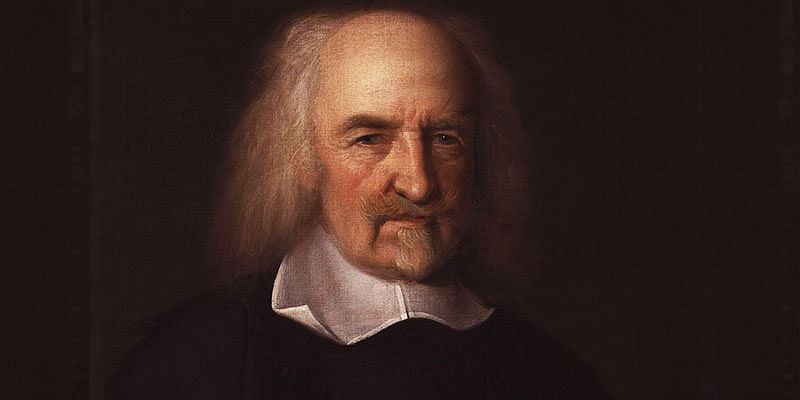
When did our politics begin? When did the thing that we think of as politics, with its to’s and fro’s, tides of opinion, its parties, elections, its winners and its losers, when did that thing start? It is hard to say, but we know that it definitely didn’t begin in 1651. Then, England was engulfed in civil war. Power was out in the open, ready to be taken by one side or the other, the King or Parliament, the winners of the war. Politics in 1651 was not about winning or losing – it was about life and death. With politics like this, thought Hobbes, who lived through that war, nothing else could survive:
“No arts; no letters; no society; and which is worst of all, continual fear and danger of violent death; and the life of man solitary, poor, nasty, brutish, and short”
Leviathan 1651
This is not our politics, but it is not alien either. We recognise it. It is, to us, the politics of a failed state, once the generals have come on the news to reassure us that it is definitely not a coup. It is the politics of Ishmaelia, or 28 Days Later. It is, to Hobbes, the ultimate failure of politics, the very thing that politics must always aim to prevent, no matter what the cost. Because civil war, the war of neighbour against neighbour and family against family, is a war of all against all, and there is no lower place a society can reach. Writing in 1651, right in the middle of the English Civil War (1642-1660) and only two years after the regicide of Charles I on a cold January afternoon outside Banqueting House, Whitehall, Hobbes was yet to fully experience the eleven years from 1649 to 1660 of kingless rule before Charles II was restored. But he had seen and read enough to know how it would end – a distrustful, vengeful society, unsure of itself. Something had to be done to make sure that this horror, this ‘Warre of all ‘gainst all,’ would not happen again.
““To this war of every man against every man, this also in consequent; that nothing can be unjust. The notions of right and wrong, justice and injustice have there no place. Where there is no common power, there is no law, where no law, no injustice. Force, and fraud, are in war the cardinal virtues.”
Leviathan 1651
In these circumstances, war is hellish because it is all consuming. In war, the things that we might value, rights to leisure, education, or other parts of social living, are subsumed under the need to survive. There is no place for individuality, for hobbies, for leisure, because if we fail in our efforts to survive the fighting, there is nothing to come next. Civil war removes the bedrock on which our social values are built and places survival right in the centre, under the lights, as the only thing left to value. The ‘cardinal virtues’ become force and fraud because none else are as useful for self-preservation. We cannot have it like this. We need someone, somewhere, to keep the peace.
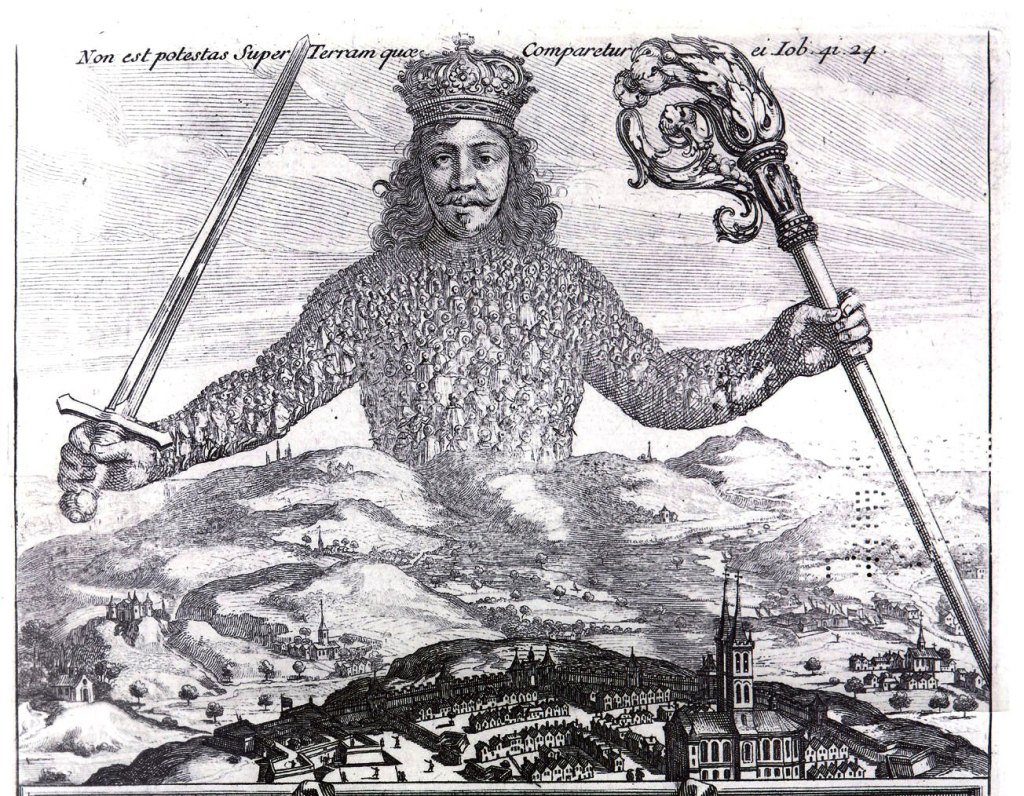
Hobbes named his book ‘Leviathan’ after a colossal, terrifying sea monster. The frontispiece of the book – what we call the front cover today – is an enormous king towering above hills, cities and churches, dominating the horizon, sword in one hand and what looks like a sceptre in the other. A titan, armed and looming over the land. This is Hobbes’ feverish image of the ‘someone’ who would keep the peace. So why this someone? Hobbes wanted his peacekeeper to be so powerful, so dominant, so monstrous that nobody, not even the most principled or power hungry groups would think of crossing him. He had to be armoured in the strongest possible fashion to avoid the worst possible eventuality, civil war, by having ‘undivided, unlimited’ power over the machinery of the state, its war-making and tax-raising functions, centring power in one literal body below which everything else would feel small and subordinate.
“For by Art is created that great LEVIATHAN called a COMMON-WEALTH, or STATE, (in latine CIVITAS) which is but an Artificiall Man; though of greater stature and strength than the Naturall, for whose protection and defence it was intended; and in which, the Soveraignty is an Artificiall Soul, as giving life and motion to the whole body;”
Leviathan 1651
But the most important detail of the front cover is less obvious and would be missed on first glance. It is the thing which, to David Runciman and Quentin Skinner, marks out Hobbes as a genuinely modern thinker, the first point in the lineage of ideas that leads to the modern state. This detail can be introduced by reference to Machiavelli.
When framing the difference between modern and pre-modern politics, Runciman invokes Machiavelli. Machiavelli is a pre-modern thinker because he sees society as made up of two distinct groups, two types of people. The first type is the people who are ruled, those who obey the laws set up by the second type, the rulers, the lawmakers, the ‘Prince’ for whom Machiavelli wrote his handbook to governing. We can see Machiavelli is pre-modern, Runciman says, because this is how he sees politics; it is the rulers and the ruled, the prince and the people, group one and group two. This is an ‘either-or’ version of politics, and, as anyone who has read Machiavelli will notice, it is often an ‘against’ version too, the rulers always keeping an eye out for those who amongst the ruled who are out to get them.
Hobbes rejected this. For Hobbes, ‘either-or’ politics was just the sort of thing he was so keen to avoid. If politics is ‘either-or,’ then opinion will split, leading to ‘us-and-them,’ and Hobbes see that as the recipe for breakdown and war. To work, his theory had to banish any possibility that the people would turn to the King and say ‘we don’t want you anymore.’
The relationship between ruler and ruled could no longer be one or the other, us or them. It had to be both, together, at once.
And that is the important detail of the front cover – the Leviathan, the looming king, is constructed, literally, out of the people that he rules. His body is a mosaic of the people, their tiny bodies and heads coming together to construct the king, who is himself made out of them. This is the modern state; the people are the ruler, and the ruler is the people too. The ruler’s power comes from the people’s agreement to be bound in law because in that agreement is the seed of their protection from the rest of the people. The body politic is made out of everyone.
Out of many, one. E Pluribus Unum, a recognisably modern principle.

“A Multitude of men, are made One Person, when they are by one man, or one Person, Represented; so that it be done with the consent of every one of that Multitude in particular. For it is the Unity of the Representer, not the Unity of the Represented, that maketh the Person One. And it is the Representer that beareth the Person, and but one Person: And Unity, cannot otherwise be understood in Multitude.”
Leviathan 1651
But Hobbes needed to find a way to make this leap, make the many into one. In a time of civil war, a time of conflict – your king or mine, your worldview or ours – Hobbes wanted to find one thing, underneath everything, that people could agree on, to bring them together.
And he did. The first aim and the first right of everyone, the thing we all want, is to stay alive. He described life as motion. To be alive is to be animated, to move, to come into conflict with others. Wherever the motion takes us, wherever we aim, we want to keep moving. We all want to avoid the collisions that might be deadly. We want peace but, as individuals, we can’t trust that the other individuals aren’t out to get us because we are diffident, unsure, nervous of placing faith in others. In moments of conflict, we cannot know how others will interpret their right to self-preservation. They may feel it gives them the right to take us down. After all, rational humans will try to pre-empt each other. We really want peace but, as individuals, we all see peace through our own lens. Peace for me is not peace for you, and even if it is, how would you know to trust me when I try to impose my way on you? As Runciman says, the consequence of everyone individually seeking peace would be what Hobbes called a ‘Warre of all against all.’
If we really want peace, we must agree collectively what peace means. But if we discuss it, we will disagree. We will fight. Hobbes’ key idea is that the thing, the one thing we can agree on, is to hand one person the right to define peace for us. We agree among ourselves to abide by the definition that this one person will choose. And if you or I wake up later to find we don’t like their definition? Too bad – they, the Leviathan, already have the power to force us to play along, as we as individuals gave them that power. We have already traded our individual liberty for collective safety. And we did it in one go. We have authorised the Leviathan to represent us, without conditions, without bargaining on how they should do it. We did not first form a group, then form an agreement with a Leviathan – we said, at once, ‘Let’s all agree to be ruled by him.’ This was the only way that we could become a group, without division. It was the only way to get protection and unity in one move. And in so doing, in agreeing to have a collective definition of peace and to be protected as a group, the multitude become “One Person”. A single body, out of many, to be ruled as one.
This is not representative democracy. It is much closer to authoritarianism than that. But it is ‘representation’ in a Hobbesian way. When individuals agree to be governed collectively, our individuality is literally ‘re-presented’ in the form and body of the Leviathan. We become part of the representer, we are the thing that the state is made of, its sovereignty authorised by us. This is the sovereign representative.
“In the very shadows of doubt a thread of reason (so to speak) begins, by whose guidance we shall escape to the clearest light.”
De Cive 1642
And this is how politics begins. We agree to be ruled collectively. The crucial choice is not Boris or Keir, us or them, Conservativism or Socialism, but state or no state, unity or disorder, politics or no politics. Out of his skeptical view of the state of nature, our diffidence, our limited knowledge, our distrust of others’ motives, Hobbes clings to one thread of reason, our shared desire for peace, and out of it builds a covenant for a state and a politics that can pull us out of our war of all against all, out of ‘us-or-them’, out of our individuality, to be drawn under the towering arm of the Leviathan towards something like society, where we can once again live as individuals, chasing whatever hopes we might have without having to keep that one eye out, over our shoulder, watching for the man trying to do us in.
 Why I Write Such Good Blogs
One thought on “Hobbes and the start of politics”